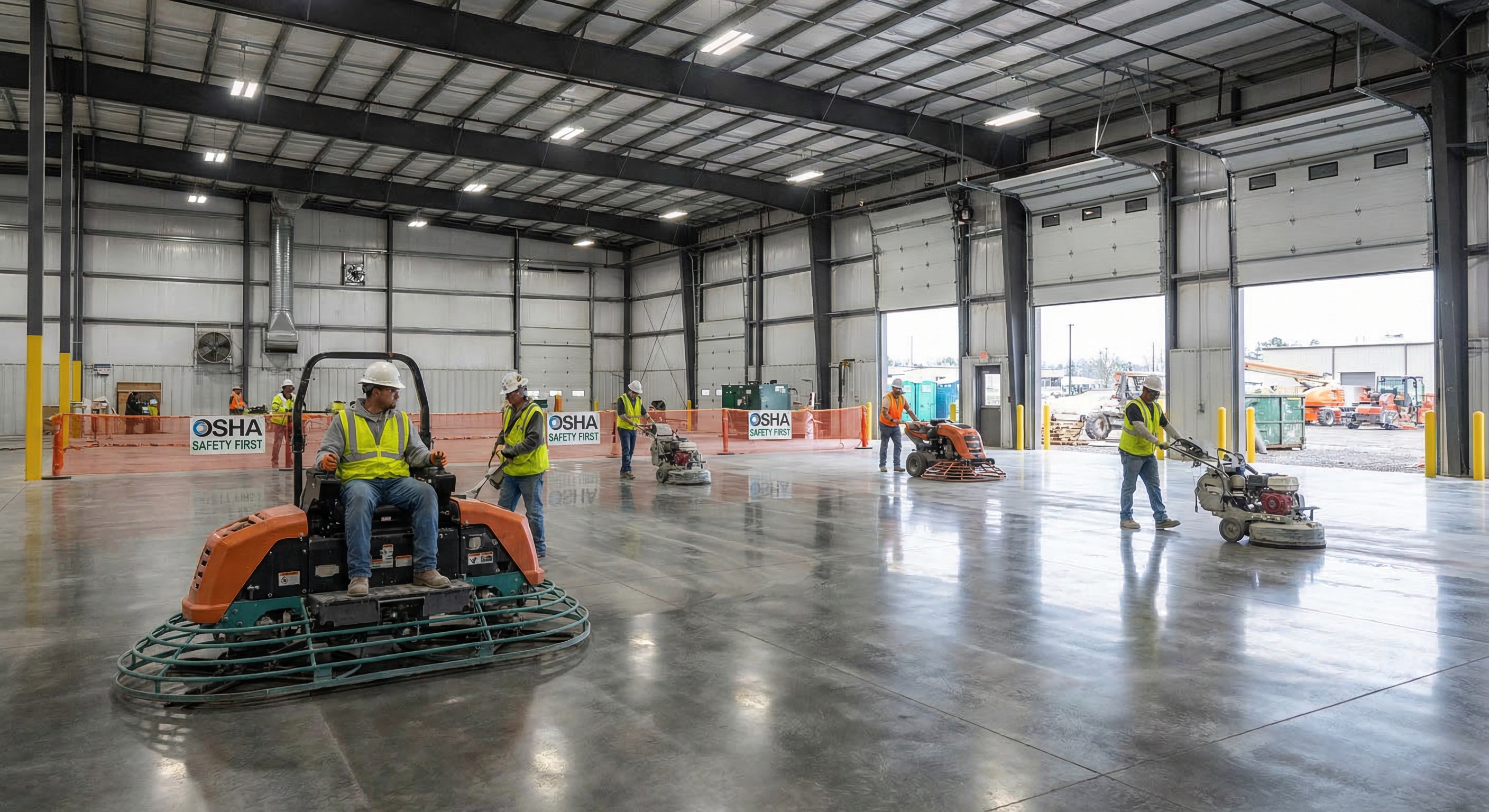
COMMERCIAL EPOXY FLOORING TULSA
The only epoxy warranty in Tulsa backed by 50+ years of concrete experience. We're concrete experts first — so we diamond-grind the slab, repair cracks right, and moisture-test before coating warehouses, retail spaces, showrooms, and manufacturing floors. That's why our floors don't peel under forklift traffic.
Free On-Site Quote, No Obligation
Fixed, written pricing based on your facility's size and traffic • 1-day polyaspartic available to minimize downtime
What Is Epoxy Flooring?
Epoxy flooring is a durable, seamless floor coating made from a two-part system — epoxy resin plus a hardener — that chemically cures into a hard plastic-like surface bonded directly to concrete. Unlike paint (which sits on top), epoxy mechanically bonds to a prepared concrete slab to form a coating 8–20+ mils thick that resists oil, chemicals, forklift traffic, and wear — which is why it's the standard floor finish for warehouses, retail spaces, showrooms, restaurants, and manufacturing facilities. Polyaspartic (often sold as "1-day epoxy") is a related polyurea coating that cures in hours instead of days and resists UV yellowing. A professionally installed commercial epoxy or polyaspartic floor lasts 10–20+ years under regular traffic; thin DIY-grade coatings typically fail in 2–4 years.
A Coating Is Only As Good As The Concrete Beneath It
Every other epoxy company in Tulsa is a painter — they can only coat whatever slab is there. TulsaCrete is a concrete company first. We pour 4000 PSI, rebar-reinforced concrete and coat it. So when the slab under your floor is engineered to resist cracking, your coating stays intact for decades instead of years.
The TulsaCrete Way
- 50+ years — outlasts every warranty we write
- Mechanical diamond grinding (no acid etch)
- Moisture vapor (MVER) test before coating
- Polyurea crack & joint repair, routed first
- 100% solids epoxy + UV-stable topcoat
- Pours, preps, & coats — one accountable party
Typical Epoxy Painter / DIY Kit
- ✗ 1–5 years in business — "lifetime" warranty on shaky ground
- ✗ Acid etching (leaves salts, weak bond)
- ✗ No moisture test (peels from below)
- ✗ Cracks painted over, not repaired
- ✗ Thin water-based coating
- ✗ Can't pour or replace bad concrete — just coat it
Epoxy Flooring Terms, Defined
100% Solids Epoxy: Pure resin + hardener with no water or solvent carrier. Produces the thickest, most durable film (8–20+ mils) and the lowest VOCs.
Polyaspartic / Polyurea: A newer aliphatic resin that cures in 20 min–1 hr per coat, is UV-stable (won't yellow), and stays flexible in cold — the basis of "1-day" systems.
MVER (Moisture Vapor Emission Rate): The amount of water vapor passing through a concrete slab, measured in lbs/1,000 sq ft/24 hrs (ASTM F1869). Most epoxy requires MVER below 3 lbs before coating.
Diamond Grinding: Mechanical surface prep using diamond abrasives to open the concrete's pores for a mechanical bond. Far superior to acid etching.
Hot-Tire Pickup: The leading cause of epoxy failure — hot tires leach plasticizer oils into a weak or under-cured coating, causing it to lift in tire-shaped patches.
Flake / Metallic: Decorative options — vinyl flakes broadcast into the basecoat (popular for retail and showroom floors) or metallic pigments for a 3D polished-stone finish.
Tulsa Is Hard On Commercial Floors
Sweating slabs in humid spring mornings. 100°F+ summers that bake cheap coatings brittle. Freeze-thaw winters that crack rigid epoxy. Add in forklift traffic, chemical spills, and wash-down cycles, and Oklahoma weather destroys facility floors that weren't engineered for it.
Sweating Slab Syndrome
Warm humid air hits cool concrete and moisture condenses on the surface. Coat over that dew film and the epoxy never bonds — it blisters. We respect the dew point on every install.
Moisture Vapor From Below
Oklahoma's clay soil and high water table push moisture vapor up through the slab (efflorescence). We MVER-test every floor and use moisture-mitigating primer when needed.
Freeze-Thaw Movement
Winter freeze-thaw cycles move the slab and crack rigid coatings. Our flexible polyurea crack repair and UV-stable polyaspartic topcoats flex with the concrete instead of cracking.
Which Epoxy System Fits Your Facility?
Every commercial floor is different — traffic type, chemical exposure, and how much downtime you can afford all point toward a different system. All systems include diamond grinding, crack repair, and a UV-stable topcoat; your final quote is fixed, with every line item detailed and nothing hidden.
Solid Color Epoxy
Cure time: 24–72 hrs
High-build 100% solids epoxy in the color of your choice. The durable, cost-effective option for warehouse, retail, and workshop floors.
Durability: High build, heavy-duty
Chemical resistance: Good
Best for: Warehouses & production floors on a flexible schedule
Epoxy Flake System
Cure time: 24–72 hrs
Full vinyl-flake broadcast over an epoxy base, sealed with a clear topcoat. Hides imperfections, adds slip resistance, dozens of color blends.
Durability: High build + texture
Chemical resistance: Good
Best for: Showrooms & retail floors needing slip resistance
Metallic Epoxy
Cure time: 24–72 hrs
Pearlescent metallic pigments create a 3D, polished-stone look. The showpiece finish for showrooms, lobbies, and high-end retail floors.
Durability: High build
Chemical resistance: Good
Best for: Showrooms & customer-facing commercial spaces
1-Day Polyaspartic
Cure time: 20 min – 1 hr per coat
Cures in hours — reopen to traffic tomorrow. UV-stable, low-odor, and handles Oklahoma's temperature swings better than standard epoxy.
Durability: Flexible, UV-stable
Chemical resistance: Excellent
Best for: Facilities that can't afford extended downtime
What determines the right system for your facility:
Square footage, current surface condition & old coating removal, linear feet of crack/joint repair, moisture mitigation if the slab fails MVER testing, traffic type (foot, forklift, or heavy equipment), and how much downtime your operation can absorb. We walk your facility, scope the work, and hand you a fixed, written quote — no cost, no obligation.
Epoxy vs Polyaspartic
The two main commercial floor coating systems — here's how they actually compare.
| Feature | 100% Solids Epoxy | Polyaspartic (1-Day) |
|---|---|---|
| Cure time per coat | Up to 24 hours | 20 min – 1 hour |
| Drive-on time | 72 hrs (7 days full cure) | Next day |
| UV stability (yellowing) | Needs UV topcoat | Inherently UV-stable |
| Film build / thickness | Thickest, most durable | Thinner, more flexible |
| Cold-weather application | Needs 50–60°F+ | Cures near freezing |
| Best for | Durability & value | Speed & Oklahoma weather |
Can't decide? Our hybrid system — epoxy base for build, polyaspartic topcoat for UV & speed — gives you the best of both. Ask about it →
TulsaCrete vs The Other Guys
Not all epoxy companies are created equal. Here's what actually separates us.
| Capability | TulsaCrete | Epoxy Painter | Franchise |
|---|---|---|---|
| Pours their own concrete | |||
| 4000 PSI + rebar substrate expertise | |||
| Mechanical diamond-grind prep | |||
| Moisture vapor testing before coating | |||
| 50+ years in business | |||
| Locally owned (not a franchise) | |||
| Single warranty, single accountable party | |||
| Fixed, written quotes with no surprise fees |
How We Install Epoxy That Lasts
Estimate & Moisture Test
We inspect your slab, run a moisture vapor (MVER) test, and quote a fixed price based on square footage, prep needs, and system.
Diamond Grinding & Repair
We mechanically diamond-grind the entire floor (never acid-etch) to open the concrete pores, then route and fill every crack with polyurea.
Primer + Base Coat
100% solids epoxy primer bonds directly to the prepared concrete, followed by a pigmented base coat — the build layer that gives epoxy its durability.
Flake / Metallic + Topcoat
We broadcast flakes or work metallic pigment, then seal with a UV-stable polyaspartic topcoat. Cure, verify conditions, and you're done.
Where Commercial Epoxy Flooring Shines
Warehouses & Manufacturing
Chemical-, oil-, and heavy-traffic-resistant finishes engineered to handle forklift and pallet-jack traffic day after day without lifting or wearing through.
Retail, Showrooms & Restaurants
High-gloss, flake, and metallic finishes that hold up to heavy foot traffic while giving customer-facing spaces a clean, polished look. Slip-resistant and easy to clean.
Large-Scale Residential (5,000+ sq ft)
We occasionally take on large residential slabs — oversized garages, shops, or barns of 5,000+ sq ft — using the same commercial-grade prep and coatings we install in facilities.
Epoxy Flooring FAQs
How much does commercial epoxy flooring cost in Tulsa?
Cost depends on square footage, current surface condition, traffic load (foot, forklift, or heavy equipment), and which coating system your facility needs — a generic rate wouldn't be accurate for a warehouse, retail space, or manufacturing floor. We inspect the slab, run a moisture test, and provide a fixed, written quote at no cost and with no obligation.
How long does commercial epoxy flooring last?
A professionally installed commercial epoxy floor lasts 10-20 years under regular forklift and foot traffic; premium polyurea and polyaspartic systems carry 20-30+ year and even lifetime warranties. Thin DIY-grade or water-based coatings typically fail within 2-4 years under industrial use. The #1 factor in longevity is surface preparation, not the product itself — which is why TulsaCrete mechanically diamond-grinds every floor and moisture-tests the slab before coating.
What is the difference between epoxy and polyaspartic?
Epoxy is a 2-coat system (base + topcoat) that cures over 24-72 hours and builds the thickest, most durable film — ideal where a facility can schedule downtime. Polyaspartic is a newer polyurea coating that cures in 20 minutes to 1 hour per coat, installs in a single day, resists UV yellowing, stays flexible in cold weather, and tolerates Oklahoma's wide temperature swings — the better fit when a warehouse or retail floor can't stay closed long. TulsaCrete recommends a hybrid — an epoxy base for build and a polyaspartic topcoat for UV stability and speed — giving you the best of both.
Can you epoxy over cracked or old concrete?
Yes, as long as the slab is structurally sound. We route out every crack and fill it with flexible polyurea, then diamond-grind the surface before coating, so the finish goes on smooth. If your slab has movement from expansive Oklahoma clay soil, we'll evaluate whether the cracks are cosmetic or point to a drainage or sub-grade problem that should be fixed first. Either way, we never just paint over cracks.
How soon can I reopen my facility floor after epoxy coating?
For 100% solids epoxy: foot traffic after 24 hours and forklift/vehicle traffic after 72 hours minimum (ideally 7 days for full chemical cure). For our 1-day polyaspartic system: walk on it in hours and run equipment on it the next day. We phase larger facilities in sections and schedule work overnight or on weekends to minimize downtime, and in Tulsa's humidity and cool weather we always verify conditions before giving the all-clear.
Why do epoxy floors peel up?
Epoxy peels almost exclusively from poor surface preparation — specifically acid etching instead of mechanical diamond grinding, or coating over hidden moisture vapor (MVER). Budget installers skip the grinding step, so the epoxy never truly bonds; it then lifts under hot tires or forklift traffic (hot-tire pickup) within 2-3 years. TulsaCrete grinds every floor and moisture-tests first, which is why we warranty against peeling.
How does Oklahoma weather affect commercial epoxy floors?
Oklahoma is genuinely hard on slabs. Sweating-slab syndrome in humid spring mornings, 100°F+ summers that bake cheap coatings, and freeze-thaw winters that crack rigid epoxy all attack a coating — and an unconditioned warehouse or loading area feels every bit of it. That's why TulsaCrete moisture-tests every slab, grinds (never acid-etches), respects the dew point during install, and uses UV-stable, flexible polyaspartic topcoats engineered for Oklahoma weather — so your floor is built for the climate and the traffic it will actually see.
Is commercial epoxy flooring slippery?
Smooth high-gloss epoxy can be slippery when wet, but we add anti-slip grit to the topcoat and flake systems have built-in texture. For areas exposed to moisture, oil, or wash-down — loading docks, kitchens, production floors — we recommend a slip-resistant flake or quartz finish. We can tune the texture to your facility's needs and any OSHA slip-resistance requirements.
UPGRADE YOUR FACILITY FLOOR
Free on-site quotes • 15-year warranty • Serving Tulsa, Broken Arrow, Jenks, Owasso, Bixby & all NE Oklahoma
Get Free Estimate